
 Chat
ChatIf you’ve struggled with acne, you know that the pimples often disappear long before the reminders do. Dark spots, uneven skin tone, and shallow acne scars can linger for months—or even years—affecting confidence and making the skin appear dull.
One of the most effective non-surgical treatments for mild acne scars and post-acne pigmentation is a professional chemical peel. When performed by a qualified medical professional, chemical peels can significantly improve skin texture, brighten the complexion, and stimulate healthier skin renewal.
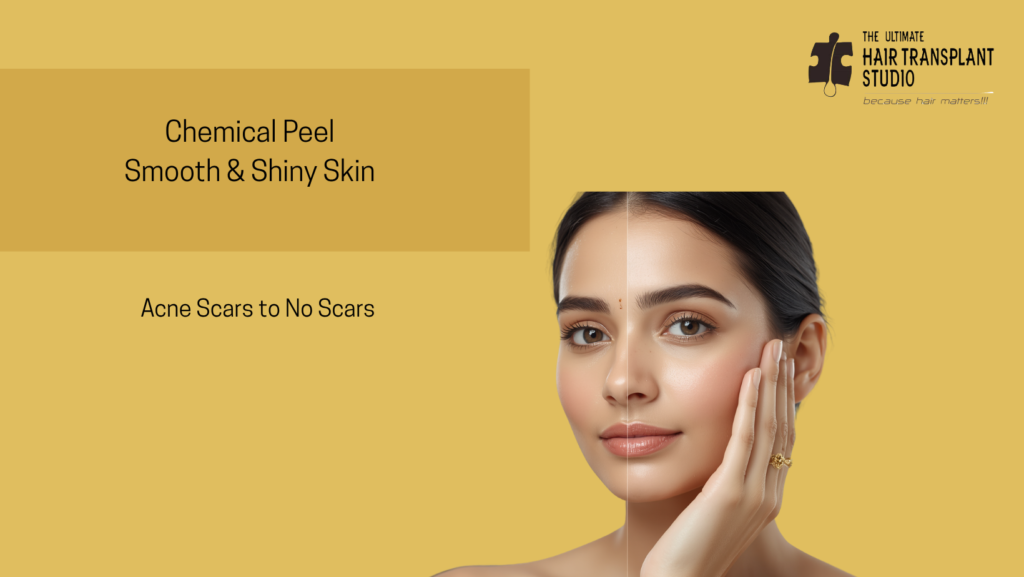
At Ultimate Hair Transplant Studio in Vadodara, we customize chemical peels according to your skin type, acne severity, and treatment goals to achieve safe and natural-looking results.
What is a Chemical Peel?
A chemical peel is a medical skin resurfacing procedure in which a carefully selected chemical solution is applied to the skin to exfoliate damaged outer layers.
As the treated skin naturally sheds over the following days, new skin cells replace the old ones, resulting in smoother, clearer, and healthier-looking skin.
Unlike home exfoliating products, professional chemical peels penetrate deeper into the skin under medical supervision, making them far more effective for acne scars and pigmentation.
How Do Chemical Peels Help Acne Scars?
Chemical peels improve acne scars through several mechanisms.
1. Removes Pigmented Skin
Many people mistake post-inflammatory hyperpigmentation (dark acne marks) for permanent scars.
Chemical peels gradually remove these pigmented skin cells, allowing fresher skin to appear.
2. Stimulates Collagen Production
Medium-depth peels encourage collagen remodeling.
Collagen is the protein responsible for keeping the skin firm and smooth.
Improved collagen production helps soften shallow depressed acne scars over time.
3. Smoothens Uneven Skin Texture
Repeated peels help reduce roughness and irregular skin texture caused by previous acne.
4. Controls Future Acne
Salicylic acid peels penetrate oily pores, reducing excess oil and helping prevent future breakouts.
Treating active acne early also minimizes the risk of developing new scars.
Which Acne Scars Respond Best?
Chemical peels work best for:
✔ Post-acne pigmentation
✔ Acne marks
✔ Mild boxcar scars
✔ Superficial rolling scars
✔ Uneven skin tone
✔ Enlarged pores
However, deep ice-pick scars and severe acne scars often require combination treatments such as Microneedling (Dermapen), PRP, subcision, fractional laser, or other collagen-inducing procedures.
During your consultation, we evaluate your skin and recommend the most suitable treatment plan.
Types of Chemical Peels Used for Acne Scars
Not every peel is suitable for every patient. The ideal peel depends on your skin type, acne severity, pigmentation, and sensitivity.
Salicylic Acid Peel
Best for:
- Oily skin
- Active acne
- Blackheads
- Acne prevention
Salicylic acid penetrates deep into the pores, helping reduce oil and inflammation.
Glycolic Acid Peel
Best for:
- Acne marks
- Dull skin
- Fine lines
- Uneven complexion
Glycolic acid gently exfoliates the skin and improves overall brightness.
Lactic Acid Peel
Suitable for:
- Sensitive skin
- Dry skin
- Mild pigmentation
Lactic acid provides gentle exfoliation with added hydration.
TCA Peel (Trichloroacetic Acid)
Ideal for:
- Moderate acne scars
- Stubborn pigmentation
- Photoaging
TCA peels penetrate deeper and should only be performed by experienced medical professionals.
What Happens During Treatment?
The procedure is simple and usually takes around 20–30 minutes.
Typical steps include:
- Skin cleansing
- Degreasing the skin
- Application of the selected peel
- Monitoring the skin response
- Neutralization (if required)
- Application of calming serum and sunscreen
Most patients describe only mild tingling or a warm sensation.
Recovery Timeline
Day 1
Skin may appear slightly pink or tight.
Day 2–3
Mild dryness begins.
Day 3–5
Light peeling usually starts.
Day 5–7
Fresh skin gradually appears.
Week 2
Skin looks brighter and smoother.
Full collagen remodeling continues over the following weeks.
How Many Sessions Are Needed?
Most patients require:
- Mild pigmentation: 3–4 sessions
- Moderate acne scars: 4–6 sessions
- Long-standing scars: Combination treatments over several months
Sessions are generally spaced 3–4 weeks apart.
Is Chemical Peel Safe for Indian Skin?
Yes. When chosen appropriately and performed by trained professionals, chemical peels are generally safe for Indian skin.
However, selecting the right peel concentration is essential to reduce the risk of post-inflammatory pigmentation.
Patients should avoid self-treatment with strong peeling products purchased online.
Who Should Avoid Chemical Peels?
Chemical peels may not be suitable if you:
- Have active skin infections
- Have open wounds
- Are pregnant (certain peels)
- Have uncontrolled eczema
- Have recent sunburn
- Have used isotretinoin recently (depending on the peel and clinical assessment)
A detailed consultation helps determine whether a chemical peel is appropriate for you.
Frequently Asked Questions
Will one chemical peel remove acne scars?
Most patients require multiple sessions for noticeable improvement. Results build gradually as the skin renews itself.
Does chemical peeling hurt?
Most people experience only mild tingling or warmth during the procedure.
Can chemical peels remove dark acne marks?
Yes. Chemical peels are particularly effective for reducing post-inflammatory hyperpigmentation and improving overall skin tone.
Will my skin peel after treatment?
Not always. Some peels produce visible peeling, while others work with minimal or no peeling. The degree of peeling does not necessarily reflect the effectiveness of the treatment.
Can I return to work the next day?
In most cases, yes. Mild redness or flaking may occur for a few days, depending on the type and strength of the peel.
Why Choose Ultimate Hair Transplant Studio, Vadodara?
At Ultimate Hair Transplant Studio, every chemical peel treatment begins with a detailed skin assessment rather than a one-size-fits-all approach. We tailor the type and strength of the peel to your skin type, concerns, and goals. Our focus is on achieving gradual, natural-looking improvements while prioritizing skin safety, especially for Indian skin tones that are more prone to pigmentation.
Whether you’re dealing with acne marks, early acne scars, or dull, uneven skin, our personalized treatment plans may combine chemical peels with complementary therapies when appropriate to help you achieve clearer, healthier skin.
Conclusion
Chemical peels are a proven, minimally invasive option for improving acne marks, superficial acne scars, and uneven skin texture. While they may not completely eliminate deep scars, they can make a noticeable difference in skin clarity and overall appearance when used as part of a well-planned treatment program.
If you’re looking for professional acne scar treatment in Vadodara, schedule a consultation with our team to find out whether a customized chemical peel—or a combination approach—is right for your skin.