
 Chat
ChatUndergoing a modern hair transplant is an incredibly exciting step toward transforming your appearance. However, because a hair transplant is a surgical procedure, achieving your ultimate dream density requires patience and proper post-operative care.
Knowing exactly what to expect during your hair transplant recovery timeline clears away anxiety, helps you plan your return to work, and ensures you protect your newly implanted grafts during their critical early stages. Let’s break down your recovery journey week by week and month by month.
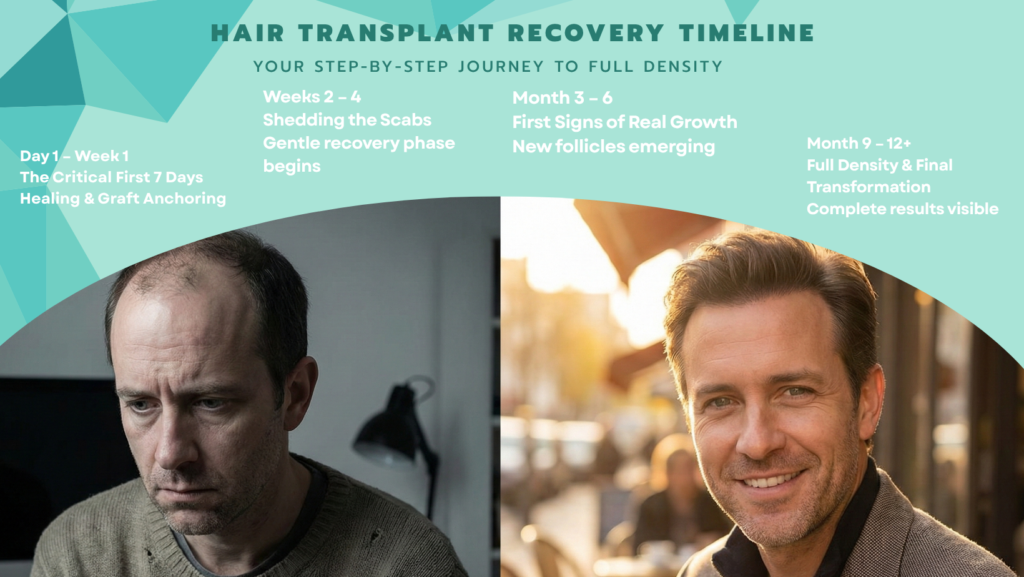
Phase 1: The Critical First 7 Days (Healing & Graft Anchoring)
The first week is all about graft survival and initial tissue healing. Because micro-incisions were made using advanced Sapphire blades or Choi pens, your body will immediately start its natural repair process.
- Days 1 to 3: You will wear a protective headband to prevent mild forehead swelling. Tiny scabs will begin to form around each implanted graft. It is absolutely crucial never to touch, scratch, or bump your headduring this phase, as the grafts are still settling into place. You will be instructed to sleep at a 45-degree angle using a travel pillow.
- Days 4 to 7: You will perform your first gentle clinical wash using specialized foam and saline sprays provided by the clinic to soothe the skin. Any initial mild tightness or redness in the donor and recipient zones will begin to drop significantly.
Phase 2: Weeks 2 to 4 (Shedding the Scabs)
By the second week, your newly transplanted roots are safely anchored deep within the dermal layers of your scalp.
- Days 10 to 14: During your daily gentle washing routine, the tiny crusts and scabs will naturally loosen and flake away. Underneath, you will see clean, short hairs.
- Weeks 3 to 4: The scalp completely heals from a structural standpoint. You can transition back to your normal sleeping positions, light exercises can be resumed, and any residual redness begins to fade into your normal skin tone.
Phase 3: Months 1 to 3 (The “Shock Loss” Testing Phase)
This is often the most mentally challenging phase for patients, but it is a completely healthy, necessary biological step.
- The Shedding Phase: Around week 3 to month 2, the temporary hair shafts attached to your newly transplanted grafts will begin to fall out. Do not panic. This is a condition known as shock loss. The hair strand is falling out, but the living permanent root beneath your skin remains entirely safe and healthy, preparing to enter a fresh growth cycle.
- The Resting Period: By month 3, your scalp may look exactly as it did before your surgery. Your hair roots are simply resting and preparing for their permanent breakthrough.
Phase 4: Months 4 to 6 (The First Signs of Real Growth)
- The Breakthrough: Around the 4-month mark, fine, baby-like hairs will begin sprouting through the surface of the skin.
- Texture Evolution: By month 6, these new hairs grow longer, begin to coarsen, and gain pigment, providing the very first visual glimpse of your permanent new hairline and improved density.
Phase 5: Months 9 to 12+ (Full Density & Final Transformation)
- The 12-Month Milestone: Between 9 and 12 months, the vast majority of your transplanted hairs will have emerged and matured. The hair becomes thick, manageable, and completely styleable.
- The Crown: Note that the crown (vertex) area has slower blood circulation than the hairline, meaning final crown density can sometimes take up to 14 to 15 months to fully peak.
Frequently Asked Questions
When can I return to my office job after a hair transplant?
Most patients can return to standard, non-physical office work within 3 to 5 days post-procedure. If you wish to keep your procedure completely private from colleagues, returning after 10 to 12 days ensures all initial scabs have fully cleared.
Can I accelerate my recovery timeline? Yes. Incorporating supportive non-surgical therapies like GFC (Growth Factor Concentrate) treatment or customized PRP sessions starting a few weeks after your transplant dramatically speeds up tissue healing, drops post-op redness, and boosts the growth speed of newly waking grafts.
Internal Link to Pillar Page: To understand how advanced tools affect your healing speed, explore our technical breakdown of [Sapphire FUE vs DHI].
Conclusion
A hair transplant recovery timeline is a steady journey of cellular change. While the shedding phase requires patience, the reward at the 12-month mark is a completely permanent, natural, and dense crown of hair that you can cut, style, and wash with total freedom.Planning your hair restoration journey and looking for the best Hair Transplant in Vadodara? At Ultimate Hair Transplant Studio, we use micro-channel Sapphire technology to minimize recovery downtime and provide structured, step-by-step aftercare support throughout your 12-month transformation.
👉 Schedule your detailed recovery consultation in Vadodara today!