
 Chat
Chat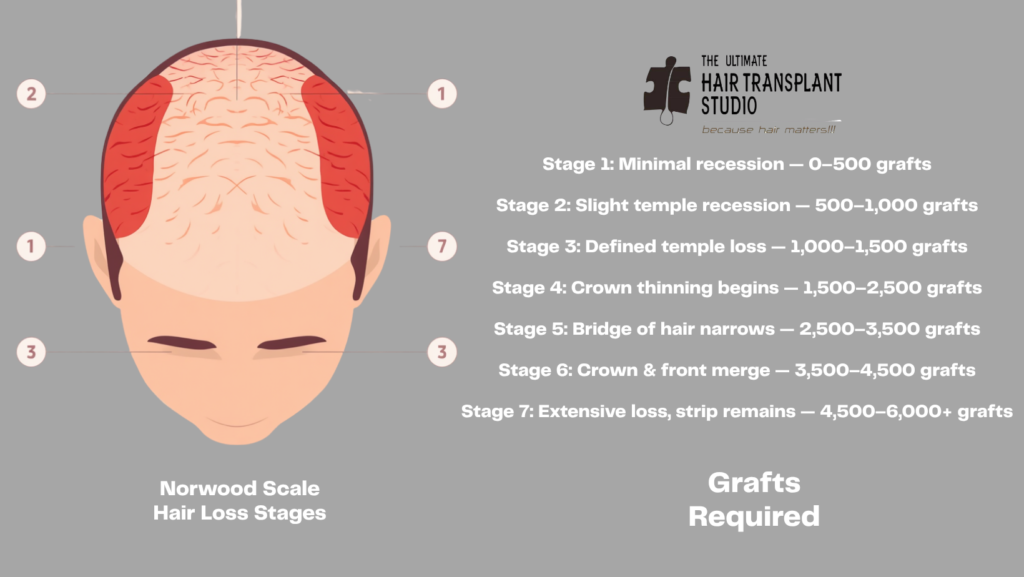
How Many Grafts Do I Need for a Hair Transplant? The Complete Guide
When planning a permanent hair restoration journey, one of the first and most critical questions you will ask during your research is, “How many grafts do I need?”
Understanding your graft requirement is not just essential for setting realistic cosmetic expectations, but it also directly determines the timeline, surgical technique, and the overall cost of a hair transplant in Vadodara. Let’s look at exactly how medical professionals calculate your required hair volume.
What is a Hair Graft?
Before diving into numbers, it is important to clarify a common point of confusion: a hair follicle graft is not the same as a single strand of hair.
A single graft is a naturally occurring microscopic grouping of hair follicles (also known as a follicular unit). On average, one hair graft contains anywhere from 1 to 4 individual hair strands. This means if a surgeon implants 2,000 grafts, you are actually receiving roughly 4,000 to 5,500 individual hairs to cover your balding areas.
Calculating Your Requirement: The Norwood Scale
Dermatologists and hair transplant surgeons categorize male pattern baldness using a standardized clinical chart called the Norwood Scale (Stages 1 through 7). Here is a general breakdown of typical graft requirements based on these progressive stages of hair loss:
Stage 2 to 3: Mild Hair Loss & Receding Hairline
At this early stage, hair loss is typically isolated to a receding hairline or deepening temples.
- Typical Target: Rebuilding a crisp, clean hairline matrix.
- Graft Estimate: 1,000 to 1,500 grafts.
Stage 4 to 5: Moderate Hair Loss
By this stage, the hairline has significantly receded, and noticeable thinning or a distinct bald patch is appearing on the crown (vortex).
- Typical Target: Lowering and filling the hairline while adding dense coverage to the crown area.
- Graft Estimate: 2,000 to 3,000 grafts.
Stage 6 to 7: Advanced Baldness
This represents extensive hair loss where the bridge of hair separating the front hairline and the crown has completely disappeared, leaving a large open surface area.
- Typical Target: Maximum possible coverage across the entire scalp, often requiring a combination of scalp and body hair harvesting.
- Graft Estimate: 3,500 to 5,000+ grafts.
[Mild: 1000-1500 Grafts] ➔ [Moderate: 2000-3000 Grafts] ➔ [Advanced: 3500-5000+ Grafts]
Crucial Factors That Limit or Increase Your Graft Count
Your final surgical blueprint is highly personalized and cannot be determined purely by looking at a chart online. During an in-person assessment, a doctor will evaluate:
- Donor Area Density: Your donor zone (the back and sides of your scalp) contains a finite number of genetically permanent hairs. If your donor density is exceptionally high, more grafts can be safely extracted without creating visible thinning in the back.
- Hair Texture and Thickness: Coarse, thick, or curly hair provides significantly more visual coverage than fine, thin, straight hair. Patients with thicker hair strands often require fewer total grafts to achieve the same visual density as someone with fine hair.
- Future Hair Loss Patterns: If you are young and experiencing active shedding, your surgical team must strategically plan your graft placement so that your results continue to look perfectly natural as your non-transplanted native hair changes over time.
Frequently Asked Questions
Can I get 5,000 grafts transplanted in a single day? While large mega-sessions of 4,000 to 5,000 grafts are entirely possible using advanced Sapphire FUE techniques, they require a highly skilled medical team and hours of precision work. For maximum graft survival and patient comfort, exceptionally high counts are sometimes split over two consecutive days.
What happens if my donor area doesn’t have enough hair grafts?
If your scalp donor area is limited due to advanced baldness, advanced clinics can safely harvest healthy, permanent hair grafts from alternative areas of your body, such as your beard or chest, to supplement your density.
Internal Link to Pillar Page: Curious about how your total graft count translates into financial planning? Read our detailed guide on the [Cost of Hair Transplant in Vadodara].
Conclusion
Determining your ideal graft count is a delicate science that balances your cosmetic goals with the long-term health of your donor area. Focusing heavily on high numbers is less important than ensuring proper placement, natural angles, and maximum graft survival rates.
Looking for an accurate, honest assessment for a Hair Transplant in Vadodara? At Ultimate Hair Transplant Studio, we use advanced high-magnification scalp analysis to calculate your exact graft requirements. We prioritize customized planning and transparent guidance to deliver maximum, permanent density.
👉 Book your personalized graft evaluation in Vadodara today!